If you follow the big names on social media talking about abuse, using any of the common terms used currently, you’ve likely heard a lot about coercive control being about a power or control behavior by the perpetrating husband over the wife.
While this can be one of the presentations, there are many other variables, one of them being more of a passive, covert, “kind” presenting behavior type (*notice the word kind is in scare quotes – because kind abuse is not kind – it’s abusive!).
Let’s get into some of the differences.
What it is
When you Google ‘coercive control’ you’ll come up with some version of the following;
Coercive control often refers to the continuous patterns of behavior that exert power or control over their victim. These behaviors deprive the victim of their autonomy, and can make her feel isolated or scared. This can have a serious impact on her day-to-day life and wellbeing.
It’s common for definitions to suggest some exertion or exercising of power and control over the wife/victim. While this is true and accurate regardless of the presentation. It may be confusing to those who might assume from the definitions that there is a bullying or aggressive type of behavior that is exerted.
That is not always the case.
Recognizing Coercive Control Variables
The potential for additional problems exists when a victim’s situation differs from the textbook/social media soundbite definitions. A common theme was reported to us in the early years right after the release of Bancroft’s book on abuse. Many of our clients read the text without being able to place their husband because he either didn’t fit all the parameters (a common misunderstanding) or he didn’t feel as cruel or aggressive. Their spouse’s type of abuse seemed more difficult to place.
Abuse Isn’t Always Aggressive
When abuse shows up in subtle ways, victims might miss the cues and patterns, normalizing them as difficult marital issues or offering other excuses that might sound like, “he doesn’t mean it,” or “he loves me, he just needs things a certain way.”
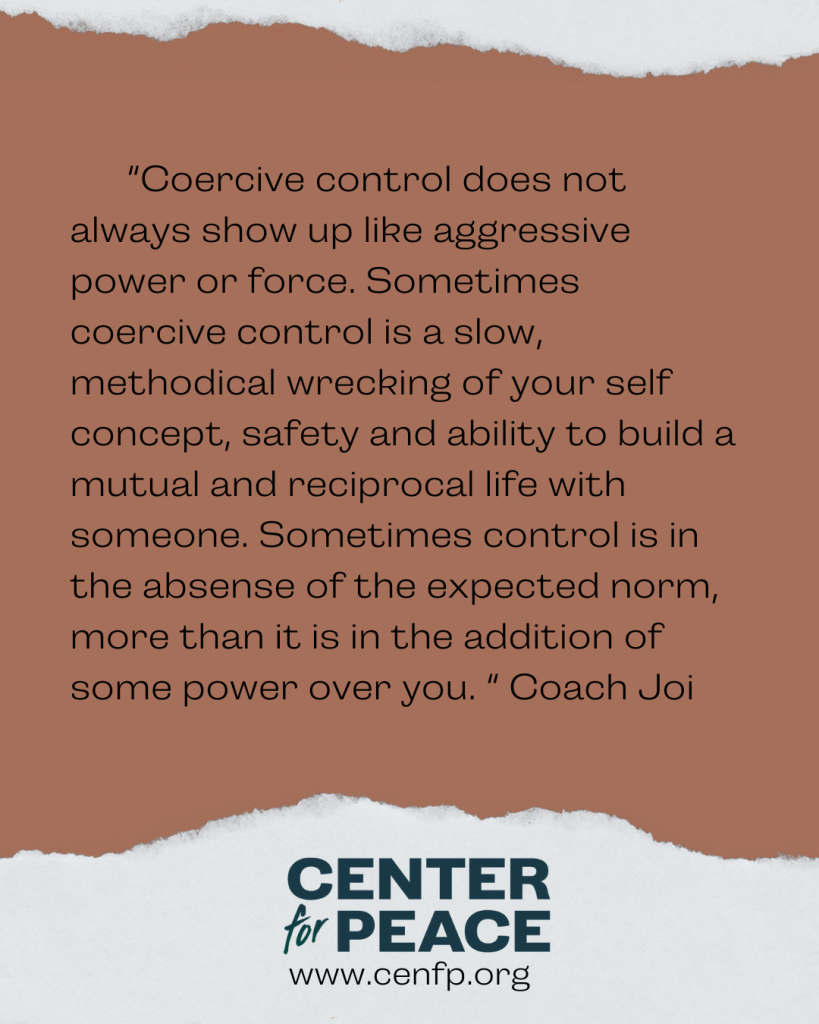
The danger of normalizing abuse of any severity, is that victims often take on the blame and accountability when the patterns are more difficult to see clearly. Subtle coercive control can often reflect more invisible patterns. Manipulation is dismissed, resulting in many years lapsing where the wife feels responsible for all of the problems.
Trapped in an Invisible Cage
You may have heard this expressed by women married to men who are coercive, but they often do not address the pain they are feeling as a result of the husband’s abuse. The sense of being trapped is often due to subtle coercion and control, masked as caring, making them feel like what is going on around them is only felt by them (they feel crazy) and the invisible nature results in feeling trapped in something they can’t solve.
As we mentioned above, the husband might like things in the home a certain way and pressures his wife to be compliant. He may tell her he’s providing for her, but she has no idea where the money goes or what the investments look like. She may not even have access to the accounts.
Men in these presentations may be moody – for no reason — around the home. They may spend a lot of time at the office, which contributes to the moodiness and demands at home of the wife. They may also be more concerned about their recreational time away than seeing to family time or to take over the home/family demands to free up autonomous time for his wife.
There’s usually a good excuse about the various types of control that make the husband sound like he’s a great guy. It’s all wrapped up in a nice little package of forcing her to keep the home and children according to his demands — with very little contribution — and way more contamination to his wife’s well-being.
Over time the wife feels overwhelmed and overworked, and has zero ability to speak to her husband about her needs and hopes.
Abuse Escalation
Eventually, the abuse and coercive control will escalate. Either due to a discovery, the exhaustion of the wife, or her wanting more of the abusive, angry husband protecting his little niche of personal benefits.
Anger tends to be the go-to for the abuser. It’s a tactic to quiet the wife’s nagging complaints. It’s used to build fear in her. During these times he might escalate into other common tactics of DARVO, blame-shifting, or even character maligning to further create threat and fear in the wife – anything to maintain his position.
All of this sounds so familiar to many of us as victims of coercive control. The big difference might be the more quiet or slower start up of the subtle versus the aggressive abuser.
What’s the Victim to Do?
No matter when you discover and begin to name the abuse and coercive tactics of control, the question remains, how do you keep yourself safe in the face of all the distress and pain? How do you make decisions when your mind feels like a sieve of confusing experiences, doubt and the twistification of events by the abuser?
We often speak about behavioral pattern recognition as the best way to ensure safety. The more you are able to determine how the abusive husband is likely to behave, the easier it is to choose your responses to him.
Safety Isn’t Always in Keeping Quiet
At Center for Peace, we refer to how a victim interacts with the abuser as a “victim response.”
It is NOT a ‘trauma response’ or an ‘emotional reaction’ As with any social or relational interaction it is a process of A’s action → B’s response, (with A being the perpetrator).
Does this mean that victims are never in the wrong, or never ask a question that might lead the abuser to exact abuse – of course not. However, the way a victim responds is not only a result of trauma. Sometimes we do things because the trauma teaches us what is safe and what is not. Other times, we risk what we understand to be a more safe response – so that we are not maligned unmercifully – we speak truth – knowing there may be a cost to us in the form of punishment.
“A victim response is her agentic response in an environment or condition where she often feels powerless” (Coach Joi).
Can You Stay Safe and Stay Married?
The answer is sometimes!
Sometimes, we figure out how to navigate the difficult interactions with the abuser. Sometimes, he escalates to a point that is untenable. Each situation is different, requiring the victim/wife to carefully plan a safe exit,
When this is the case, it can be helpful to have trained abuse specialists walk alongside you.
At Center for Peace, we help you find your unique way of restoring safety and self-trust after abuse. We walk alongside you as you choose the life you want to build. As you acquire the education you need, helpful guided coaching, and good community support will help you achieve what you need for stability and peace.
Join us in Our Community
If you are not a part of our Women’s community, please consider joining us there today.
Additionally, we have drop-in support groups each Monday and Thursday – we’d love to see you there. We’ve been where you are. We’re also trained in abuse and Coercive Control. We recognize what many call, ‘marriage problems.’