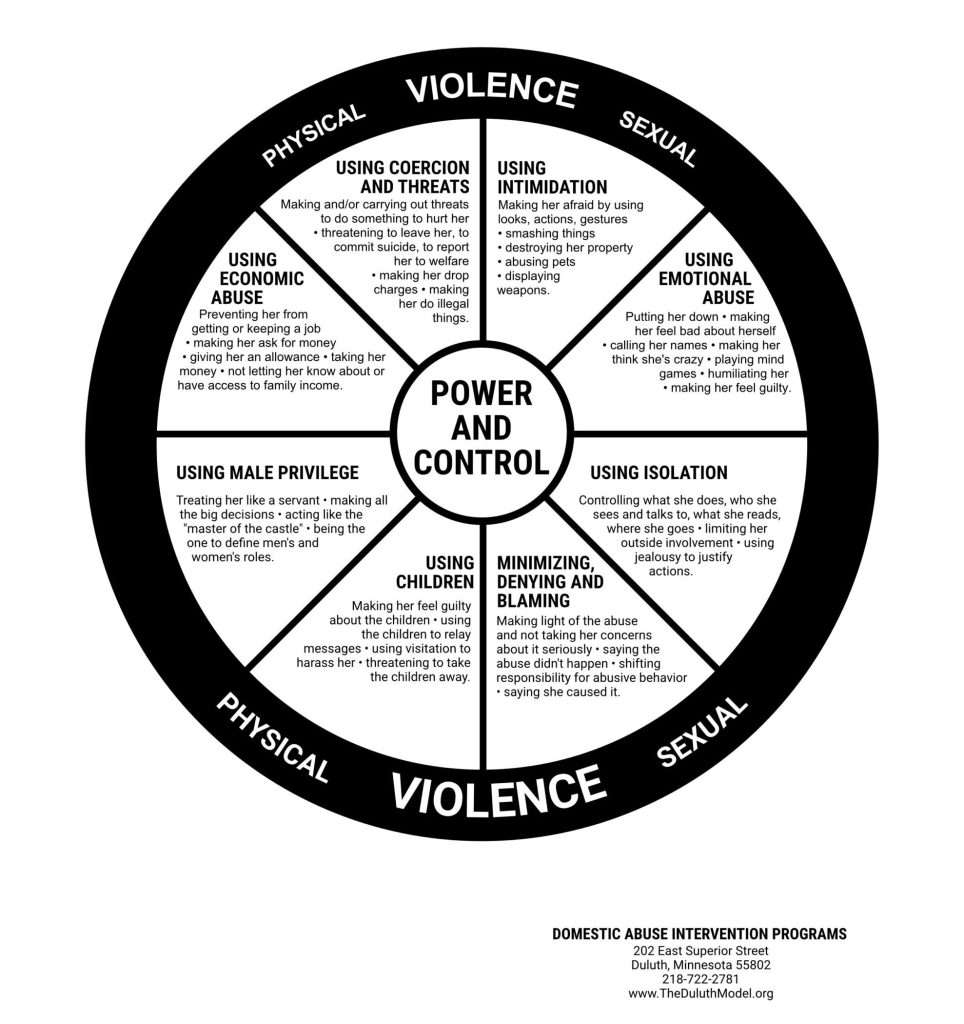
You are all likely aware of the Power and Control Wheels (Pence & Paymar 1983) that shifted the trajectory of the field of domestic violence. Initially these wheels were meant to visually represent patterns of male batterers towards their intimate partner. As valuable as these tools are, they have become siloed in the domestic abuse/violence field, creating a narrow definition of abuse, limiting the social mindset to that of solely physical acts.
Unfortunately, way too many women know the problem with this social mindset – abuse and coercive control are exponentially more convoluted than what this original tool was developed for.
In the 42 years since the inception of this tool, we have a bit more information on this problem, but we are nowhere near finding solutions to the belief systems that support men believing they can power over women using these kinds of control tactics.
Battleground for Evidence
In a paper by Garcia-Moreno, et. all (2008), the point was raised that researchers continue to argue strongly for the capturing of women’s experience with male domestic violence. Stating that researchers needed to more fully examine the patterns of coercive control tactics and the implications this has on women as perceived property (“An unfortunate result of this pattern of thought” cj). They further stated that this type of subjugating women has deep roots in beliefs of domination and control.
This comes as no surprise to those of us who work in this field. We understand experientially and academically that we are critically far behind in terms of understanding the patterns of thinking that result in this type of maltreatment of women by men.
We are equally concerned with the dearth of inadequate language when it comes to articulating the discourse of coercive control. Without the ability to have a stable dialogue within our communities on this topic, we will continue to revert to old ideologies and wrong conclusions for the issue at hand.
Likewise, there is concern with the misassigned theoretical models applied to the behaviors of men using Coercive Control in their intimate relationships as being the cause. It is all too easy to see elements of thought in a model that has some similarity to a behavior and thereby assign it to cause. Correlation has never been the precursor to causation. In this population, this has never been more critical to correct.
Understanding Discursive Control
In the field of Intimate Partner Abuse (IPA), the application of discursive control can be seen in the multiplicity of ways in which ideas, theories or arguments are presented relative to the field of IPA and Coercive Control or “Targeted Partner Abuse©” (TPA – coined by Center for Peace, 2018).
This flow of information is a form of power and control that is used to establish control over the problem itself, as well as the applications of treatment, types of diagnoses, etc. Since language is the foremost manner for shaping thought, this is the most powerful tool we have as humans.
Discursive control in the TPA©/IPA field can be seen in the narrow terms and explanations for the problems women across the world face. It can also be seen in the way in which level-setting ideologies of “women do this too” are used to dilute the problem or normalize it as a type of marriage issue.
The way TPA©/IPA is framed will amplify or attenuate the severity of the issue at hand. Because TPA©/IPA is a social issue, discursive control can sever the voices and silence the stories of countless women and children who continue to be abused by the men in their lives they believed would love and protect them.
Discursive control seriously shapes the public opinion towards these heinous acts, to the point that the following statement will be viewed as “man-hate” or “feministic” rather than a long overdue wakeup call.
“Targeted Partner Abuse© is the malevolent treatment of an intimate partner while masquerading as an impeccable human to elevate one’s social standing” (Coach Joi)
Power and Control
Noah Webster, in his 1828 Dictionary writes the following on power.
“The exertion of power proceeds from the will, and in strictness, no being destitute of will or intelligence, can exert power; power in man is active or speculative. Active power is that which moves the body; speculative power is that by which we see, judge, remember, or in general, by which we think” (1828).
Thus, the execution of power is a process of one’s will or agency. It is not an inherent right or privilege, but rather it is one’s actions resulting from belief or character. When we exercise power over another human being, we strip the acted upon individual of autonomy by the means of one’s oppressing control and subjugation – not by consent. Abuse in an intimate relationship is experienced by a wife who does not have the ability to counter it, negotiate an alternative or manage the situation in a way that would alleviate it.
This is human violence, whether there is physical contact or not. It is violent in that words or actions used unilaterally against the wife’s will and well-being. It is violent due to the physically and mentally distressing impacts of this type of wielded power and control. The results are catastrophic for the marriage, the children and for societal systems micro and macro.
When a couple marries, there is an often-unstated belief that power will be distributed equally for the betterment of both individuals. Our greatest power as human beings is in the management of our capacities to share intellectually, emotionally and spiritually the exercise of power in our relational interactions. This practice lends to safety and trust with one another.
Center for Peace Philosophy
This post is in no way an exhaustive look at power and control. Nevertheless, as part of our mission, we affirm that lasting peace requires the agentic engagement of each individual in every human interaction. It is in the language and discourse of dignity and regard for one another – even when we are not aligned in our viewpoints – that we can sustain our sought after dignity for each human soul.
There is power in the affirmation of human dignity and respect that can be present in every relationship we engage in. The power we speak of is not the kind that seeks to dominate or control, but the power that nurtures empathy, equality, and understanding. When power is shared equitably, when individuals are valued for their humanity rather than their status or position, we create the foundation for a society that is truly peaceful.
At its core, the notion of power in relationships is about mutual respect and the recognition of the inherent worth of every person. It is the strength to listen deeply, the courage to confront injustice, and the commitment to act with compassion. These are the qualities that transform conflict into collaboration and discord into harmony.
We believe that by cultivating this power of dignity and respect, we empower each other not only to coexist, but to thrive. A peaceful human society is one where power is exercised in ways that foster connection, inclusivity, and justice.
As we continue this journey together, let us hold this truth close: peace is not a distant dream, but a tangible possibility, built on the foundation of respect in every relationship.
For those of you hoping to achieve this end objective in your relationships please reach out to us for a discovery call as we begin filling our next year-long program.