If there is one comment shared with me by the wives I work with more than others, it is that the lies are more difficult to deal with than other pattern of behavior. Lies destroy so much. Lies, like so many other ideas and theories in mental health, we’ve whittled down their meanings with clever variations and explanations so that the significance of the action is lost.
In this post, let’s discuss the topic and the impact to both the liar and the victim.
Classifying Lies
Who knew there were so many different classification or types of lies? Just look at this graphic pulled from the internet.
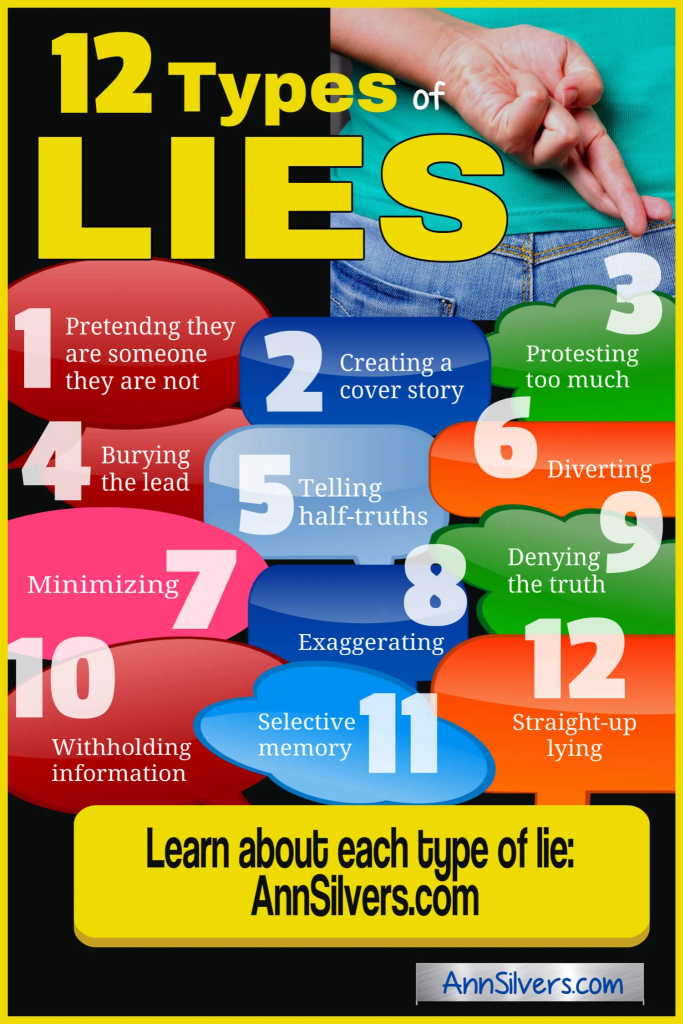
Do we really need so many iterations for dishonesty? We mean no disrespect to annsilvers.com, but a lie is a lie – period!
Whether you are making things up, leaving things out, minimizing, exaggerating, denying or even paltering – it’s all a lie. These cute categories do nothing to lessen the impact on the ones hurt by the lies.
For those of you who believe that lying is ok, or that it doesn’t hurt anyone – well…
Abusers and Lies
There are some who categorize lies by the kind of abuser or so-called ‘personality disorder.’ A sociopath for example lies to lie. They lie without reason – but then so do many of the abusers we’ve worked with at Center for Peace that we would not categorize or diagnose in this category. Lies are reflective of character, as is all types of abusive actions. Low-character individuals see no point in following pro-social values.
Pontificating, Prevaricating and Paltering
No matter how magniloquentic the individual or the term used to describe the lie – the practice of fabrication, especially when addressing behaviors conducted in a marriage or executed upon a wife, this is reprehensible.
No one cares how skilled you are at your deception, except you – the abusive liar. The lies matter when you are so delusional that you believe you can get away with it. Lies have nothing to do with what happened to you in your past, your emotional maturity or immaturing. Regardless of what you read on Reddit, Quora or any other Google search outcome.
Lies are a clear sign of a defective character.
No Excuse for your Deception
There’s no excuse for the deception. Liars lie to protect themselves. Here are a few more of the narratives about lies.
- White lies, believing you are protecting someone, but that in and of itself, is a lie.
- Self-protective lies, as stated above, benefit only the liar, never the one being lied to.
- Pathological lies are not stated because of some need or chemical imbalance. They are simply the evidence of a consistent pattern of disregard of the truth.
- Compulsive lying is not due to an inability to stop. Similar to so-called ‘pathological’ lies – it is a pattern of behavior that has a long backdrop of self-imposed permission and very low character attributes.
The Cost of Deception
Lies come at a cost, both to the liar and the one being lied to. In marriages where abuse is present, the consistent pattern of lies destroys any trust. Lies create great emotional pain and destroy any/all respect for the individual lying.
If you are working to correct your abusive past, the lies you’ve told may be the most difficult to recover from. Without trust, you will find it very difficult to re-establish autonomy for yourself. So much has to be monitored when the pattern of lies has been severe and abusive. Many abusive men have a difficult time seeing this as part of the repair. They tend to bend this into narratives about the wife controlling him.
For the abused victim to begin to trust, it will take a lot of effort, kindness and understanding on the part of the abuser. You cannot expect an abused wife to just believe you when you’ve done so much damage by lying, blaming, gaslighting and verbally abusing her about behavioral events or betrayal.
Many studies suggest that it is difficult to detect lies in others – just like it is difficult to detect or read emotions in others. If the one being lied to does not construct patterns of deception, they will not assume there is deception coming from the story of the liar. Once it is revealed to the victim the depth and breath of the deception, there will be considerable pain to work through. It will cloud her ability and often her willingness to believe her abuser in the future.
Lies and the Brain
Lies spread faster and build deeper roots in relationships than almost any other pattern of thinking and behaving. If you have been telling your wife lies for years, your own neural patterns are going to be set for a while.
We have the kinds of brains that will base current action on past constructions and predictions. If you’ve set yourself up to habitually lie, it is going to take great effort to change the construction habits you built for yourself. Each situation where you may have lied in the past, will require careful pause and reassessment to change the choice from deception to truth. This does not mean you CAN’T tell the truth, it means you have created a big struggle for yourself.
Moral and Ethical Reasons
For obvious moral and ethical reasons, lies are going to create problems for everyone. Lies take on a life of their own, making anything a liar says difficult to believe – even if he is speaking the truth.
In a well-known children’s book, ‘The Big Fat Enormous Lie’ (Sharmat and McPhail, 1993)

The little boy in the story quickly learns how heavy lies are and how uncomfortable they can be to live with. He has to make a decision about which is worse, promoting his lie, or telling the truth.
The problem many abusers have is that telling the truth doesn’t yield the desired outcome for them – so lies become a means to an end – a way to manipulate and control. Like with other types of abusive behaviors, they compound and exacerbate until the abuser has dug himself a ditch he cannot extract himself from.
Choices have consequences. The choice to lie is no exception to that rule.
Correcting Abusive Lies
If you find yourself caught in the trap of deception, there is a way out. There is a process for you to rebuild yourself, and to learn to live a life free of the bondage you created for yourself and your wife. At Center for Peace, we walk alongside you and your wife for a full year, mentoring, teaching, and guiding you in applying healthy thinking and improved social interaction tools, using the best of science, mental health and decades of our own experience in the field.
Schedule a discovery call today. The new year-long program begins in January.